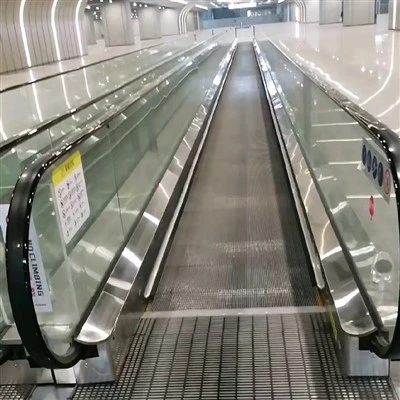
When it comes to the design and operation of moving walkways, one of the most frequently asked questions is: What is the maximum number of people that can use a moving walkway at once? As a supplier of moving walkways, I’ve delved deep into this topic to provide the most accurate and practical answers. Moving Walkway
Understanding the Basics of Moving Walkway Capacity
The capacity of a moving walkway is determined by several key factors. Firstly, the width of the walkway plays a crucial role. A wider walkway can accommodate more people side – by – side. Generally, moving walkways come in different widths, typically ranging from 0.6 meters to 1.8 meters. For a standard 0.6 – meter – wide walkway, it can usually allow one person to stand comfortably. In contrast, a 1.8 – meter – wide walkway can accommodate up to three people walking or standing side by side.
Secondly, the speed of the moving walkway affects its capacity. Faster – moving walkways can transport more people within a given time frame. Most moving walkways operate at speeds between 0.5 m/s and 0.75 m/s. At a speed of 0.5 m/s, a person can cover a certain distance in a relatively longer time compared to a walkway moving at 0.75 m/s. This means that a faster – moving walkway can handle more people per unit of time.
The third factor is the behavior of the users. In some cases, people may stop on the walkway to look around, talk to others, or adjust their belongings. This can disrupt the flow of traffic and reduce the overall capacity of the walkway. On the other hand, if users follow a consistent pattern, such as standing on one side and walking on the other (as is common in many places), the walkway can operate more efficiently.
Calculating the Maximum Capacity
To calculate the maximum number of people that can use a moving walkway at once, we can use a simple formula. Let’s assume that the width of the walkway is (W) (in meters), the speed of the walkway is (V) (in m/s), and the average space occupied by a person is (S) (in square meters).
The cross – sectional area of the walkway (A = W\times1) (assuming a unit length of 1 meter for simplicity). The number of people per unit length of the walkway (n=\frac{A}{S}).
The flow rate (Q) (the number of people passing a certain point per second) is given by (Q = n\times V).
For example, if we have a 1 – meter – wide walkway moving at a speed of 0.5 m/s, and assume that each person occupies an area of 0.2 square meters. The number of people per unit length (n=\frac{1\times1}{0.2}=5). The flow rate (Q = 5\times0.5 = 2.5) people per second.
In an hour (3600 seconds), the maximum number of people that can use the walkway is (N=Q\times3600 = 2.5\times3600=9000) people.
However, this is a theoretical calculation. In real – world scenarios, we need to consider factors such as the starting and stopping of the walkway, the presence of obstacles, and the behavior of the users.
Real – World Considerations
In real – world applications, the maximum capacity of a moving walkway is often lower than the theoretical value. For instance, in a busy airport or shopping mall, people may not stand or walk in a perfectly orderly manner. There may be congestion at the entrance and exit of the walkway, which can slow down the overall flow.
Moreover, safety regulations also limit the number of people on a moving walkway. These regulations are in place to ensure that in case of an emergency, people can evacuate the walkway quickly and safely. For example, in some areas, there are requirements for a certain amount of free space on the walkway at all times to prevent overcrowding.
Another important consideration is the maintenance and durability of the walkway. Overloading a moving walkway can cause excessive wear and tear on its components, such as the conveyor belt, motors, and rollers. This can lead to more frequent breakdowns and higher maintenance costs.
Case Studies
Let’s take a look at some real – world case studies to understand the practical capacity of moving walkways. In a large international airport, a 1.2 – meter – wide moving walkway is installed in a high – traffic area. During peak hours, the walkway is observed to carry around 4000 – 5000 people per hour. This is lower than the theoretical capacity calculated based on the width and speed of the walkway, mainly due to the chaotic behavior of passengers, who may stop to check their luggage or look for signs.
In a shopping mall, a 0.8 – meter – wide moving walkway is designed to connect different floors. The mall management has set a limit of 3000 people per hour to ensure a smooth flow of customers and reduce the risk of accidents. This limit is also based on the mall’s safety regulations and the expected behavior of shoppers.
Optimizing Moving Walkway Capacity
As a moving walkway supplier, we offer several solutions to optimize the capacity of our walkways. Firstly, we can design walkways with adjustable speeds. This allows the operator to increase the speed during peak hours to handle more people and reduce the speed during off – peak hours to save energy.
Secondly, we provide clear signage and guidance to encourage users to follow a consistent pattern. For example, we can mark the "stand" and "walk" sides of the walkway clearly, which can improve the flow of traffic and increase the overall capacity.
We also offer advanced monitoring systems that can detect the number of people on the walkway in real – time. This information can be used to adjust the speed of the walkway or take other measures to ensure efficient operation.
Conclusion
Determining the maximum number of people that can use a moving walkway at once is a complex task that involves considering multiple factors such as width, speed, user behavior, and safety regulations. While theoretical calculations can provide a rough estimate, real – world scenarios often result in lower capacities.
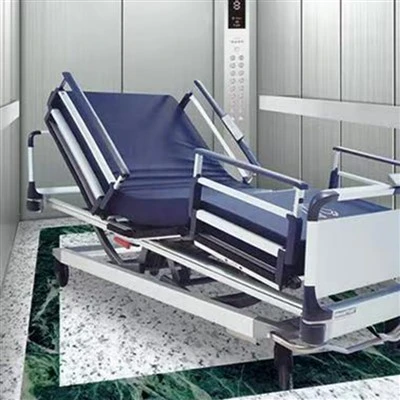
Hospital Elevator As a moving walkway supplier, we are committed to providing high – quality products and solutions that can optimize the capacity of our walkways. If you are in the market for a moving walkway and want to discuss your specific requirements, please feel free to contact us for a detailed consultation. Our team of experts will be happy to assist you in choosing the right moving walkway for your needs and ensuring its efficient operation.
References
- "Handbook of Elevators and Escalators" by O. O. A. S. T. A. S. (This is a general reference for elevator and escalator design, which also contains relevant information on moving walkways).
- Industry reports on the design and operation of moving walkways from professional organizations in the field of transportation and building engineering.
Ningbo Dongao Elevator Co., Ltd.
As one of the most experienced moving walkway manufacturers and suppliers in China, we also support customized service. We warmly welcome you to buy high quality moving walkway for sale here from our factory. For quotation, contact us now.
Address: No. 16 Xiapan Road, Ninghai County, Ningbo City, Zhejiang Province
E-mail: 13777289058@163.com
WebSite: https://www.daelevator.com/
