If you’ve ever flipped on a laptop, charged a home battery, or powered a small industrial machine, you’ve interacted with a power factor correction (PFC) power supply—even if you didn’t know the name. As someone who’s spent 12 years designing, testing, and shipping these units out of our workshop, I’ve gotten more questions than I can count from electricians, product engineers, and even DIY tinkerers: “Why does this matter?” and “What happens when the grid gets wonky?” Today, I’m pulling back the curtain on exactly how our PFC power supplies manage power when the grid throws curveballs—because that’s the whole point of what we do. PFC Power Supply

First, let’s get on the same page about what PFC actually is, because it’s not just another tech buzzword. The grid supplies alternating current (AC) that fluctuates in a smooth sine wave, rising and falling 50 or 60 times a second, depending on where you live. Most old-school power supplies don’t play nice with that sine wave. Instead of drawing power evenly, they pull big chunks when the voltage is high, and almost nothing when it’s low. That’s called low power factor, and it’s a problem for two big reasons: it wastes energy (think higher utility bills for factories or offices) and it can strain the whole grid. Our PFC power supplies fix that by aligning the current draw with the voltage sine wave, bringing power factor close to 1 (the ideal) so energy is used efficiently.
But the grid isn’t perfect. It’s not just a smooth sine wave sitting in a lab—real-world grid conditions change all the time. You might see sags (when voltage drops briefly, like when a big HVAC unit turns on in an office building), swells (when voltage spikes, like when a neighborhood’s air conditioners shut off en masse), or even distortions from nearby heavy machinery that pump extra harmonics into the line. Our PFC supplies have to handle all this without dropping a single volt to the device they’re powering. Let’s break down how that works, step by step.
Start with the front-end AC input stage. This is where the supply first grabs power from the grid, and it’s the first line of defense against grid chaos. Unlike non-PFC supplies, which use a simple diode bridge to turn AC into direct current (DC), a PFC supply uses a more complex circuit: a boost converter, plus a control loop that’s like a tiny, super-fast brain. That control loop doesn’t just align current and voltage—it monitors incoming grid voltage every microsecond, adjusting the current draw to match whatever the grid is serving up. If the grid voltage sags 10% for half a second, the loop cranks up the current just enough to keep the power flow steady. If there’s a small spike, it backs off just enough to avoid overloading the internal components.
What about bigger grid events, like a 20% sag that lasts for a few seconds? That’s where the bulk capacitor comes in. The capacitor acts like a tiny battery bank inside the supply, storing extra power when the grid is strong and releasing it when the grid is weak. Wait a second—we used to skimp on capacitors years ago, right? Not anymore. Our PFC supplies use high-quality, long-life electrolytic capacitors (we source ours from industrial-grade suppliers, not cheap knockoffs) that can hold enough energy to cover short grid dips. I remember a test we did a couple years back for a client in a rural area where the grid has frequent sags. We simulated a 30% sag over 5 seconds, and the supply kept delivering consistent DC voltage to their industrial sensors without a single drop-out. The client told us later that cut their downtime from an average of 4 hours a month to 12 minutes—all because of that capacitor buffer working with the PFC control loop.
Harmonic distortion is another big grid headache. You won’t see it as a visible flicker, but those extra frequency waves from heavy motors, welders, or even other electronics can mess with power supply internal circuits, overheat components, and even cause other devices on the same line to act up. Our PFC design targets this specifically. The boost converter we use isn’t just for power factor—it’s tuned to reject common harmonic frequencies (like the 3rd, 5th, and 7th harmonics that pop up most often from industrial equipment). The control loop adjusts the current waveform to cancel out those harmonics before they can get into the supply’s internal circuitry. I worked on a project a few years ago for a food processing plant that had a fleet of industrial mixers running 24/7. Before they switched to our PFC supplies, their LED lights would flicker every time a mixer turned on. After we installed our units, the flicker was gone, and their total power usage dropped by 8%—that’s hundreds of dollars a month in savings for a single plant.
Now, let’s talk about variable input voltages, because grid conditions don’t just fluctuate in time—they vary by region too. Some countries run at 100V, some at 240V, some swing between both depending on the time of day. Older power supplies often only worked for a narrow voltage range; you’d have to carry different units for 120V and 240V applications. Our PFC supplies are universal input, meaning they can handle anything from 90V to 264V AC without any manual switching. How does that work? The PFC control loop automatically adjusts the boost converter’s output to a fixed DC bus voltage, regardless of what the incoming grid is serving. If you plug one of our supplies into a 120V line, it boosts to 380V DC. Plug it into a 240V line, it still boosts to 380V DC. That fixed DC bus is what feeds the rest of the power supply circuitry, so the output voltage to the device stays rock solid, no matter what the grid is doing. We had a customer a while back that imports our supplies to remote areas in Southeast Asia where grid voltage can swing up to 20% above or below nominal. They told us our supplies outperformed every other brand they’d tested, because even when the grid dipped to 80V, our units kept their equipment running at full capacity.
But no design is perfect, right? We’ve learned that reliability under varying grid conditions isn’t just about the circuit—it’s about testing. We test every single one of our PFC power supplies for 48 hours straight under simulated grid conditions that are way worse than anything a customer is likely to see. We blast them with sags, swells, harmonics, and even temporary blackouts to make sure they hold up. Last year, we updated our testing protocols to include real-world grid data from 12 different countries, so we’re not just testing in a lab—we’re testing against the exact conditions our customers actually deal with. That’s why our warranty is 5 years, which is twice as long as most other PFC suppliers in the market.
A lot of people ask why we don’t just use off-the-shelf PFC modules. The truth is, off-the-shelf modules are designed for average grid conditions. They don’t have the custom tuning we do for harsh environments—like construction sites, rural areas with weak grids, or industrial facilities with heavy nearby machinery. When a supply is powering a critical piece of equipment, like a medical device or a factory robot, you can’t afford it to cut out for even a millisecond. That’s what sets our supplies apart: we design the PFC circuit specifically to handle the worst-case grid conditions our customers face, not just the ones on a spec sheet.
Let me wrap this up with a real example, because numbers and specs don’t mean as much as a story. A few months back, we got a call from a renewable energy company that installs off-grid solar systems for remote mountain cabins. Their old power supplies would shut down whenever the solar panel output dipped on cloudy days, because the grid (their solar system) was fluctuating constantly. They tried a handful of PFC supplies, but none could handle the rapid voltage swings that come with variable solar power. They sent us a sample of their old system, and we tested our PFC supply under the exact same voltage swings—going from 18V to 30V in less than a second, over 10,000 cycles. Our supply didn’t skip a beat. Now, every one of their new off-grid systems uses our PFC power supplies, and they’ve cut their callback rate for power issues by 90%.
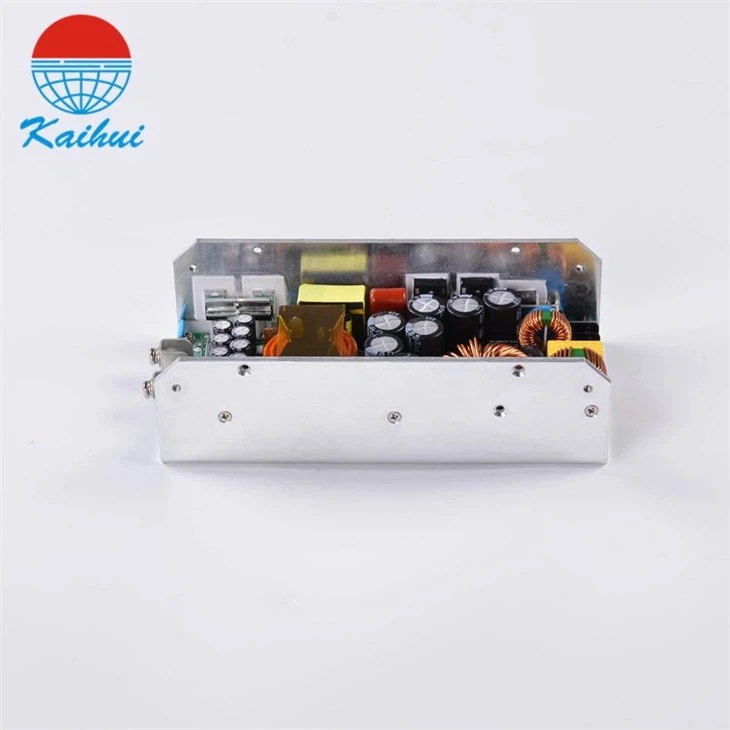
At the end of the day, a PFC power supply’s job isn’t just to correct power factor—it’s to be a reliable bridge between the messy, unpredictable grid (or whatever power source you’re using) and the sensitive electronics that depend on steady power. That means handling sags, swells, harmonics, and all the little quirks of real-world power without compromising performance. If you’re tired of power supplies that fail when the grid is less than perfect, or you’re looking to upgrade your system to save on energy costs while improving reliability, we’d love to talk. Whether you’re an engineer designing industrial equipment, a solar installer working on off-grid projects, or a facility manager tired of high utility bills from inefficient power supplies, our team can help you find the right PFC solution for your needs. Don’t hesitate to reach out to learn more about how our supplies perform under even the toughest grid conditions.
Open Frame Switching Power Supply References
- Rashid, M.H. Power Electronics Handbook, 4th Edition. Elsevier, 2017.
- Yazdani, A., & Iravani, R. Voltage-Sourced Converters in Power Systems: Modeling, Control, and Applications. Wiley-IEEE Press, 2010.
- International Electrotechnical Commission (IEC). IEC 61000-3-2: Electromagnetic Compatibility (EMC) – Part 3-2: Limits – Limits for harmonic current emissions (equipment input current ≤ 16 A per phase), 2018.
- Bose, B.K. Modern Power Electronics and AC Drives. Prentice Hall, 2002.
Guangzhou Kaihui Electronics Co., Ltd.
Guangzhou Kaihui Electronics Co., Ltd. is one of the most professional pfc power supply manufacturers and suppliers in China, specialized in providing the best customized service. We warmly welcome you to buy high quality pfc power supply made in China here from our factory.
Address: 2F BLDG8, Standard Ind.Park, Dongchong Town, Nansha District 511453, Guangzhou, Guangdong, China
E-mail: amy@gzkaihui.com
WebSite: https://www.kaihuipowersupply.com/
